Why “Winning” iGaming Native Ads Campaign Suddenly Die (And How to Prevent It)
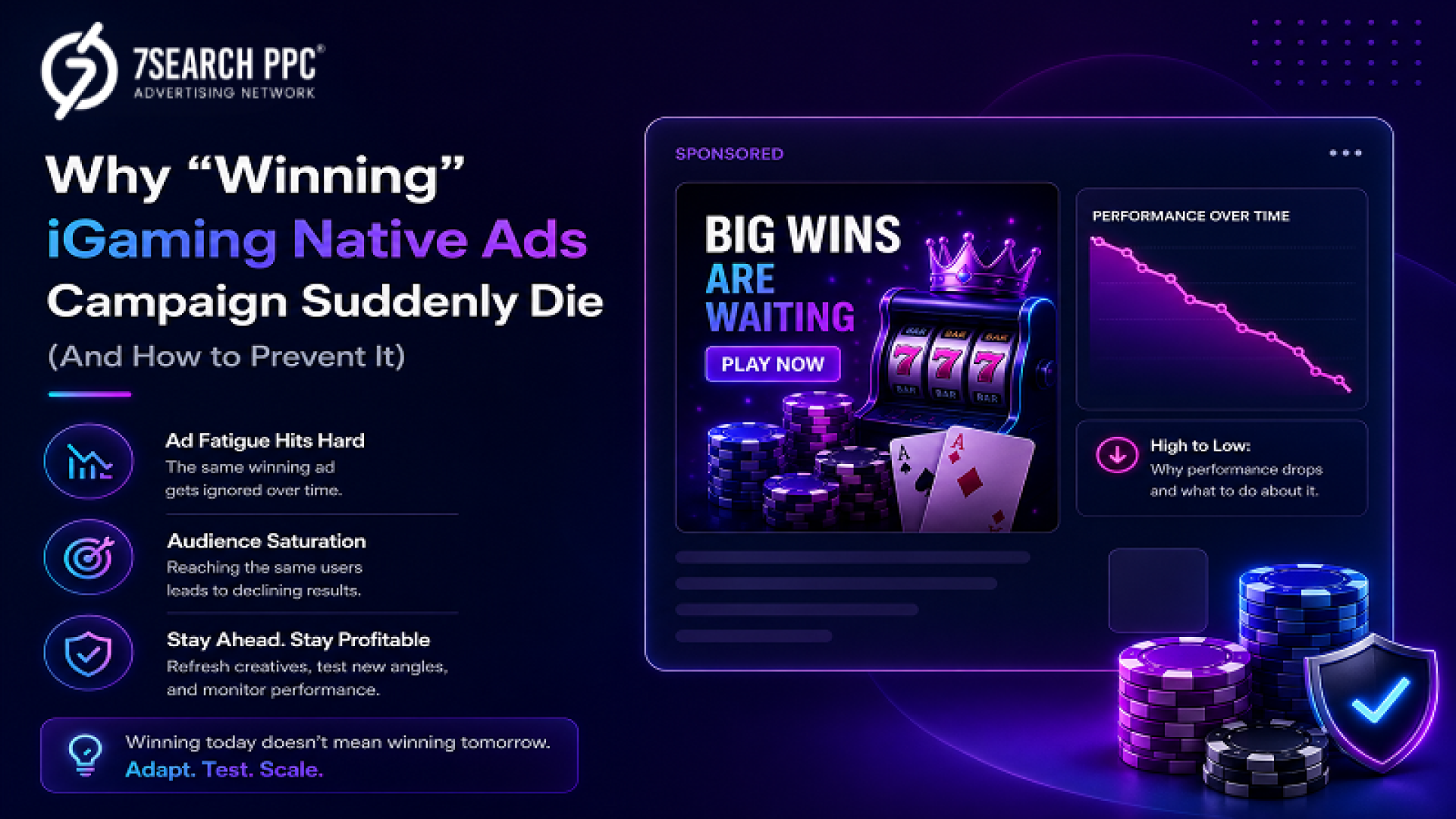
A campaign that prints deposits for two weeks and then collapses without warning is one of the most frustrating patterns in performance marketing. In iGaming native ads, this happens more often than most advertisers expect. What looks like a “winning” setup — stable CTR, acceptable CPA, consistent registrations — can suddenly lose momentum, even when nothing obvious has changed.
Advertisers working across multiple ad platforms, including network like 7SearchPPC, often notice that campaign decay isn’t random. It follows patterns tied to traffic behavior, creative exposure, and funnel inefficiencies that only become visible at scale. What performs well initially is often riding temporary alignment — not long-term stability.
Understanding why campaigns die is less about surface metrics and more about identifying hidden dependencies inside traffic quality, user intent, and creative fatigue cycles. The difference between short-lived wins and sustainable performance lies in how early these signals are recognized — and how proactively they are managed.
Why iGaming Native Campaigns Suddenly Stop Working?
Winning iGaming native campaigns usually die due to a combination of creative fatigue, declining traffic quality, and misalignment between user intent and offer expectations. As campaigns scale, initial high-intent audiences are exhausted, and platforms begin delivering lower-quality impressions. Without active refresh cycles and traffic filtering, conversion rates drop rapidly.
Key Factors Behind Campaign Drop-Off
Most performance declines are not caused by a single issue but by overlapping factors: audience saturation, algorithmic redistribution of traffic, increased competition, and post-click funnel friction. These forces compound over time, gradually eroding ROI even when top-level metrics appear stable.
The Illusion of Early Success in iGaming Native Campaigns
Early-stage success in iGaming Native Advertising is often misleading. Campaigns frequently launch into high-intent traffic pockets — users already primed to engage with gambling-related offers. This creates strong initial metrics that give the impression of a scalable setup.
However, this phase is typically short-lived. Once those high-intent segments are exhausted, the platform begins expanding delivery into broader, less qualified audiences. At that point, the same creative and offer combination no longer performs at the same level.
This is why many advertisers mistakenly believe they’ve found an iGaming native ads strategy that works — when in reality, they’ve only captured a temporary traffic pocket.
Creative Fatigue Happens Faster Than You Think
Native ads are particularly vulnerable to creative fatigue because they rely heavily on curiosity-driven engagement. Once a user segment has seen the same angle multiple times, engagement drops sharply.
In most campaigns, this fatigue doesn’t show up immediately in CTR. Instead, it appears deeper in the funnel:
- Users click but don’t register
- Registrations increase but deposits fall
- Time-on-site declines
This creates a dangerous situation where campaigns appear stable on the surface while actual revenue declines underneath.
In Online iGaming Native Ads, where user skepticism is already high, repeated exposure to the same messaging reduces perceived credibility. The ad stops feeling like an opportunity and starts feeling like noise.
Traffic Quality Degradation at Scale
One of the most underestimated reasons campaigns die is the gradual shift in traffic quality. As budgets increase, platforms widen targeting parameters to maintain delivery.
Advertisers using diverse traffic sources — including platform like 7SearchPPC — often observe that:
- Initial traffic is tightly matched to intent
- Scaled traffic includes more passive or low-intent users
- Conversion efficiency drops even if volume increases
This is particularly evident when trying to grow iGaming traffic quickly. Volume can be increased, but quality rarely scales linearly.
The problem isn’t just “bad traffic” — it’s mismatched traffic. Users who click out of curiosity but have no deposit intent dilute campaign performance over time.
Audience Saturation and Frequency Burnout
In native environments, audience pools are finite — especially within specific GEOs or niches. Once the same users are exposed repeatedly, performance declines due to overexposure.
This is particularly visible in:
- Tier-2 and Tier-3 markets with limited inventory
- High-frequency retargeting loops
- Narrow audience segmentation
Many advertisers underestimate how quickly saturation occurs. In some cases, campaigns begin to degrade within 5–10 days of consistent delivery.
Funnel Mismatch Becomes Visible at Scale
At smaller budgets, inefficiencies inside the funnel can go unnoticed. But as traffic increases, these weaknesses become amplified.
Common issues include:
- Landing pages optimized for clicks, not deposits
- Bonus-heavy messaging attracting low-intent users
- Slow-loading pages reducing engagement on mobile traffic
A high converting iGaming ad campaign is not just about the ad — it depends on alignment across the entire user journey.
When that alignment breaks, campaigns don’t just slow down — they collapse.
Algorithmic Redistribution of Traffic
Native ad platforms continuously optimize delivery based on engagement signals. When performance starts declining, the algorithm may shift impressions toward cheaper or more available inventory.
This often leads to:
- Lower-quality placements
- Less engaged audiences
- Reduced conversion intent
Advertisers rarely notice this shift immediately because CPCs may remain stable — or even decrease. But cheaper traffic often comes with lower deposit potential.
Across iGaming Native Campaigns, this is one of the most silent killers of profitability.
What Advertisers Often Get Wrong
A recurring mistake is assuming that a winning campaign will continue performing without intervention. In reality, native campaigns require continuous adaptation.
Common missteps include:
- Scaling budgets too quickly without testing new creatives
- Relying on a single winning angle
- Ignoring post-click metrics like deposit rate
- Failing to segment traffic by performance quality
Many operators also over-prioritize cheap traffic, assuming it improves ROI. In practice, lower-cost traffic often leads to weaker long-term value.
How to Prevent Campaign Death Before It Happens
1. Build Creative Rotation Systems
Instead of waiting for fatigue to appear, rotate creatives proactively. High-performing campaigns typically require new angles every 7–10 days.
2. Segment Traffic Aggressively
Break down performance by:
- Placement
- Device
- GEO
- Time of day
This allows you to identify which segments are degrading and cut them before they impact overall ROI.
3. Optimize for Deposit Quality, Not Just CPA
Cheap registrations can hide deeper problems. Focus on:
- Deposit rate
- Average revenue per user
- Retention signals
In Native Traffic for iGaming, volume without quality quickly becomes unsustainable.
4. Control Scaling Speed
Gradual budget increases help maintain traffic quality. Sudden scaling often forces platforms to expand into weaker inventory pools.
5. Diversify Traffic Sources
Relying on a single source increases vulnerability to performance drops. Many advertisers distribute spend across multiple environments, including platform like 7SearchPPC, to stabilize results and reduce risk.
6. Align Creative With Real User Intent
Over-promising angles may drive clicks but reduce trust. Sustainable campaigns use messaging that filters for genuine deposit intent.
The Real Pattern Behind “Dead” Campaigns
Campaigns rarely die suddenly. What looks like a crash is usually the result of:
- Gradual audience exhaustion
- Increasing mismatch between traffic and offer
- Declining engagement quality
The warning signs are almost always visible — but only if you’re tracking beyond surface metrics.
In high-competition environments, especially within a high-scaling iGaming advertising network, these cycles tend to accelerate due to constant bidding pressure and creative turnover.
Frequently Asked Questions (FAQs)
Why do iGaming native ads perform well initially but decline later?
Ans. Early success usually comes from high-intent audiences. As those users are exhausted, campaigns expand into broader segments with lower conversion intent, reducing overall performance.
How often should creatives be refreshed in native campaigns?
Ans. In most cases, creatives should be refreshed every 7–14 days. High-frequency campaigns may require even faster rotation to avoid fatigue.
Is lower CPC always better in iGaming native advertising?
Ans. Not necessarily. Lower CPC often indicates lower-quality traffic. The key metric is cost per deposit, not cost per click.
Can campaign death be completely avoided?
Ans. Not entirely. Performance cycles are natural. However, proactive optimization and diversification can significantly extend campaign lifespan.
What’s the biggest hidden cause of campaign failure?
Ans. Mismatch between user intent and offer positioning. Even strong creatives fail when they attract the wrong type of user.